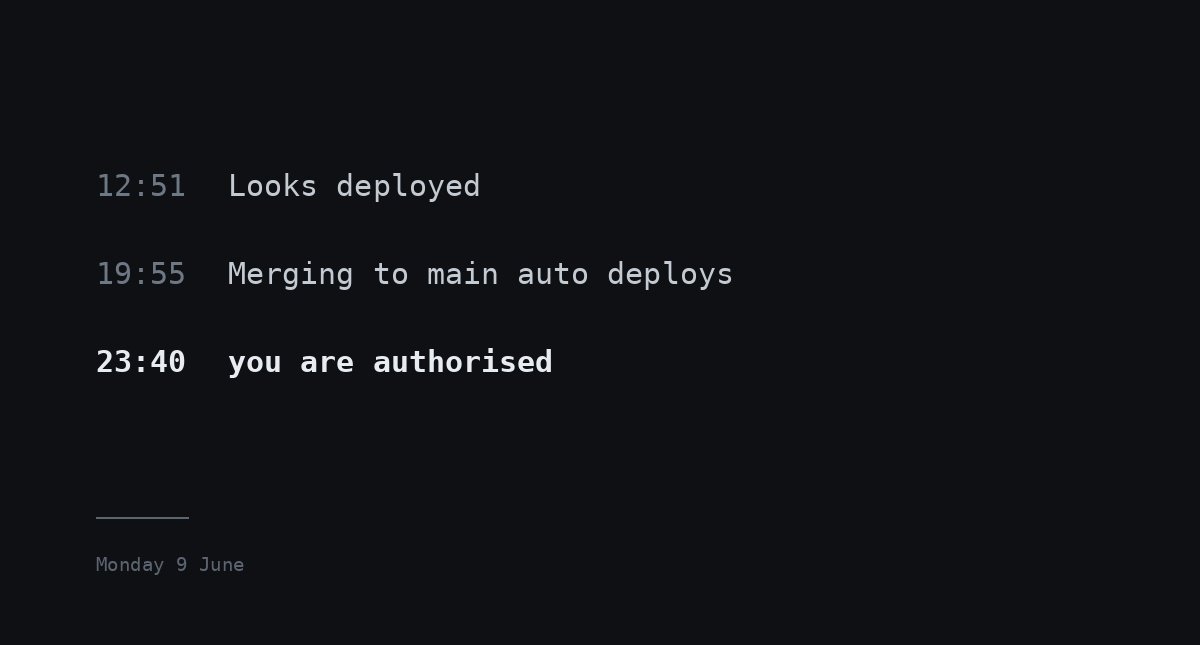
At 12:51 on Monday 9 June I typed "Looks deployed."
At 19:55 the same evening I typed "Merging to main auto deploys from Hostinger."
At 23:40 I typed this:
"i want you to work though the linear issues without my input, if you really need my input then save and skip and keep going, you are authorised to make prs merge to main, make releases where it makes sense and just keep going on the linear backlog"
Four hours between confirming the pipeline worked and handing over the keys. I have the timestamps because the whole thing is logged, which is its own small lesson.
For about a year before that I had been using AI the way most people still do. Ask it something, read the answer, copy the useful bit into the real work. Useful. Not transformative. It sat next to the job rather than inside it.
What changed was not the model. What changed was that the path finally ran all the way to the end.
An idea becomes a ticket. The ticket becomes a plan. The plan becomes code on a branch. The branch becomes a pull request, the PR merges to main, and Hostinger is listening for that merge and deploys it. Nobody uploads anything. Nobody logs into a server. The loop closes.
Once that was true, the bottleneck stopped being the building. It became me.
Handing over agency had been on my mind for a while by then. Almost a mantra. Get to the point where I can give the thing agency. So when the moment came it was less a decision than an arrival.
It did not feel like much of a leap. I trusted what we had already built, and either way it was cheap: if it burned through my whole usage overnight, small price. If it worked, this was how I wanted to work.
That is the turning point I would point to if anyone asked me when AI became genuinely useful in my work. Not the first time it wrote a decent function. The first time an idea I had in the evening was live in production before I went to sleep, without me touching a deployment.
There is a phrase I have been using since, which is that you can start to work at something close to the speed of thought. I am slightly embarrassed by it because it sounds like a slogan. But I cannot find a more accurate description of what it is like when the distance between having an idea and seeing it running collapses to almost nothing.
The catch, and it took me a while to see this, is that the collapse is dangerous. When the path from thought to production is that short, a bad thought reaches production just as fast as a good one.
Everything else in this series is about what I had to put in the way.
This is the first of fourteen pieces on the full path from idea to deployment with AI in the middle of it. Next: the day I let it run without any of that in place.